
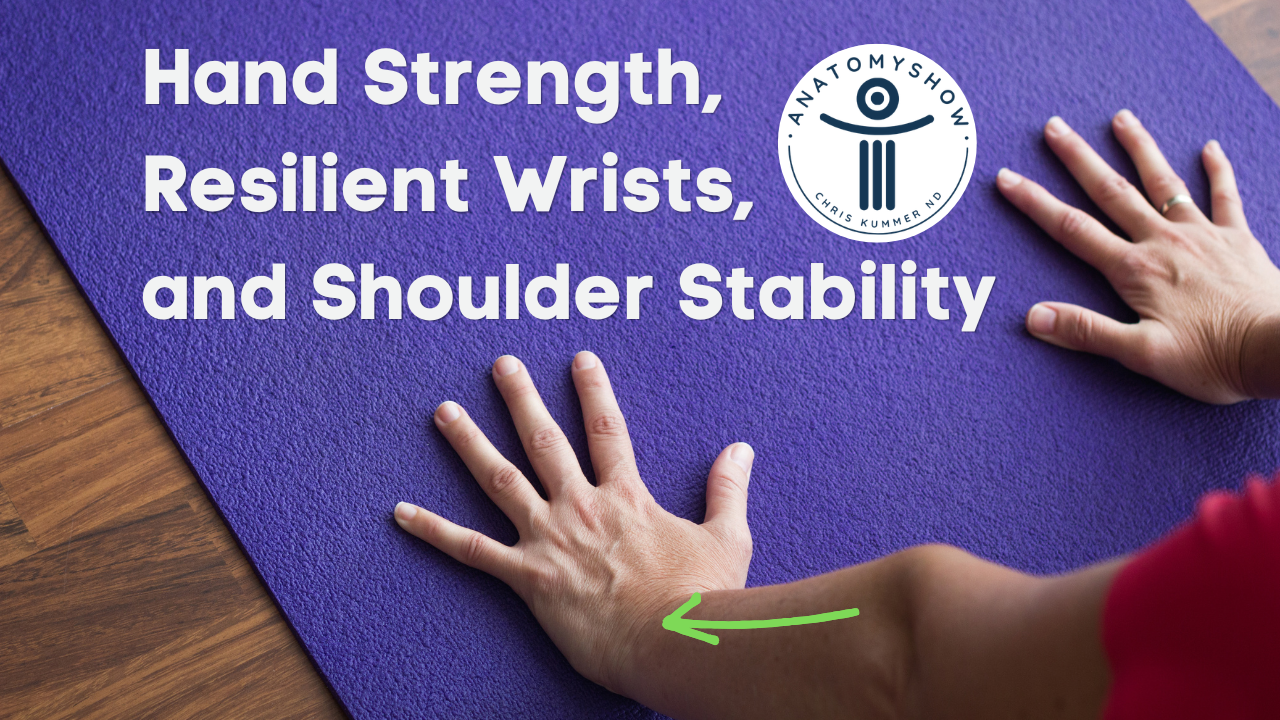
Hand Strength, Resilient Wrists, and Shoulder Stability
May 06, 2026A fascia-informed approach to pain-free weight bearing on the hands in yoga
Wrist discomfort is one of the most common reasons people modify—or avoid—weight-bearing poses on the arms in yoga. Plank, Downward Dog, Chaturanga, arm balances: they all ask a lot from relatively small joints. Yet the wrists are rarely the true problem. More often, discomfort reflects how force is (or isn’t) being shared across the entire upper limb—hands, wrists, forearms, elbows, shoulders—and the fascial network that links them top the body.
When we zoom out from isolated joints and look through a fascia-informed, biomechanical lens, a clearer picture emerges: strong, responsive hands; adaptable, well-prepared wrists; and stable, well-integrated shoulders are all expressions of the same system working together.
Let’s unpack how that system works—and how to train it.
The Wrist Is a Messenger, Not a Weak Link
The wrist is structurally designed for mobility and fine control, not for taking the full load of your body weight in end-range extension. In poses like Plank or Upward Dog, the wrist is pushed toward its extension limit while simultaneously being asked to bear load. If the rest of the system doesn’t contribute, the wrist takes the hit.
Common contributors to wrist pain in yoga include:
- Collapsing into the heel of the hand (overloading the radial side)
- Passive hanging in the ligaments instead of active muscular support
- Limited shoulder flexion, shifting load downward
- Poor scapular control (especially lack of protraction and upward rotation)
- Weak or underused hand muscles
Rather than “fixing the wrist,” the goal is to redistribute load across a broader, more capable network.
The Hand: Your First Line of Load Distribution
Your hands are not passive platforms—they’re dynamic, adaptable interfaces with the ground.
Build the “Active Hand”
An active hand spreads and organizes force more evenly. Instead of dumping weight into the base of the palm, you create a lifting and gripping action that engages the muscles of the hand.
Think:
- Spread the fingers
- Press evenly through the fingers and knuckles, especially the index and thumb base
- Actively “claw” the mat without gripping rigidly
- Create a slight doming through the palm (sometimes called hasta bandha)
This distributes load into the metacarpals and away from the most vulnerable wrist structures.
Fascia Connections:
Through a fascial lens, the hand doesn’t stop at the wrist. The fascia of the hand connects the palm through the forearm flexors, across the elbow, and into the chest via the biceps and chest fascia.
When you actively engage your hands:
You’re not just strengthening grip—you’re tensioning a connection that supports the entire anterior arm to the body
This can also help stabilize the elbow and influence shoulder positioning
A passive hand generally means a disconnection from load sharing.
Preparing the Wrists for Load
Even with great technique, wrists need gradual exposure to load and range with constant practice and over time.
Mobility + Strength, Not Just Stretching
End-range wrist extension needs both:
- Mobility (access to the range)
- Strength (control within that range)
Useful prep includes:
- Wrist circles under light load
- Palm pulses (gentle forward/back shifts)
- Fingertip push-ups (scaled)
- Back-of-hand stretches (for extensor balance)
The key is dosage: short, frequent exposure builds resilience better than occasional overload.
Shoulder Stability: The Real Game Changer
If the wrists are the messenger, the shoulders are often where the message originates.
In weight-bearing yoga, the shoulder complex should:
- Flex fully (arms overhead relative to torso)
- Protract (spread and stabilise the shoulder blades)
- Upwardly rotate and posteriorly tilt the shoulder blades
Without this, the body shifts load downward—into the wrists.
Serratus Anterior: The Unsung Hero
A major player here is the serratus anterior, which helps anchor the scapula to the rib cage and allows effective load transfer.
When the serratus is underactive:
- The chest collapses
- The shoulder blades wing off the rib cage or retract excessively
- Load bypasses the shoulder girdle and drops into the wrists
When it’s working:
- The upper back feels broad and supportive
- Force is shared through the torso
- The wrists feel lighter—even in strong poses
Simple cue: “Push the floor away” in Plank or Downward Dog is helpful in some cases.
Fascia Connection: From Hand to Opposite Hip
Fascial continuity means that what happens in your hand can influence your core and even your legs.
The layered fascia connections contribute to how forces travel diagonally through the body. In a well-integrated Plank:
- Pressing through the right hand can connect into the left side of the torso
- Shoulder stability links with core engagement
- The body behaves like a tensegrity structure, not a stack of parts
This reduces localized strain and improves efficiency.
Common Compensation Patterns
Recognizing patterns is key to change.
1. Dumping into the Wrist
Collapsed palm
Elbows hyperextended
Shift: Engage the hand, activate muscles around joints more effectively, and bring shoulders over wrists in plank.
2. Locked Elbows, Disconnected Shoulders
“Hanging” in the joints / passively overextended elbow
Minimal muscular engagement
Shift: Micro-bend the elbows and engage surrounding muscles.
3. Collapsing Chest in Downward Dog
Limited shoulder flexion
Weight shifts forward into hands
Shift: Bend the knees, lengthen the spine from the hips, and prioritize shoulder positioning over straight legs.
Rebuilding Capacity: A Smarter Progression
If wrist pain is already present, the solution isn’t to push through—it’s to scale intelligently.
- Modify the Load
- Use fists or props to reduce wrist extension
- Practice on an incline (hands on a block or bench)
- Reduce duration and intensity
Build Strength Elsewhere
- Forearm plank (less wrist load, more shoulder/core work)
- Resistance band serratus exercises
- Controlled scapular push-ups
Gradually Reintroduce Load
- Start with short holds
- Focus on even distribution
- Increase complexity only when it feels sustainable
Technique Cues That Actually Matter
In poses like Plank, Downward Dog, or Chaturanga:
- Spread the fingers and root through the fingers and knuckles
- Actively grip the mat to activate the hand
- Press the floor away to engage serratus anterior
- Keep the back of the neck long (avoid collapsing chin and head forward)
- Let the shoulders support the wrists—not the other way around
Beyond the Mat: Daily Load Matters
Your wrists don’t only experience stress in yoga.
Typing, phone use, and general posture all shape tissue capacity. A fascia-informed view reminds us that:
- Repetitive low-load strain adds up
- Variety of movement builds resilience
Strength + mobility + variability = durability
Simple additions:
- Regular hand/wrist movement breaks
- Hanging or light pulling work
- Grip training (farmer’s carries, light hangs)
A Fascia-Informed Summary
When you stop treating the wrist as an isolated hinge and start seeing it as part of a connected, responsive system, the strategy shifts:
- Hands distribute load
- Wrists adapt and transmit force
- Shoulders organize and support the system
- Fascia links and distributes it all into the whole body
Pain often appears where load accumulates—not where the problem begins.
Closing Thoughts
Building hand strength, wrist resilience, and shoulder stability isn’t about forcing your body into ideal shapes. It’s about improving how forces move through you.
Train your hands to participate. Prepare your wrists to tolerate load. Teach your shoulders to lead movements.
From a fascia-informed perspective, you’re not just strengthening parts—you’re upgrading the conversation between them.
And when that conversation improves, your practice becomes lighter, stronger, and far more sustainable.
Don't miss what's happening!
New posts, education, and movement ideas delivered to your inbox.
We hate SPAM. We will never sell your information, for any reason.
Blog post by:
