
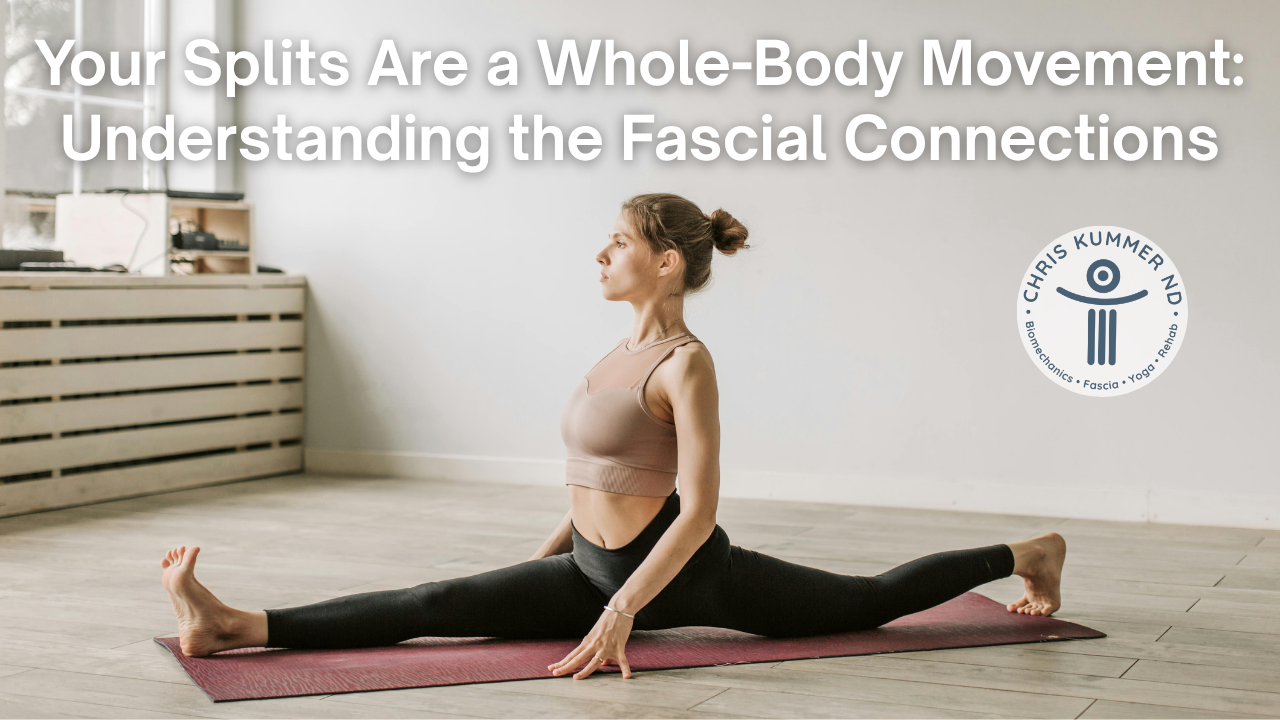
Your Splits Are a Whole-Body Movement: Understanding the Fascial Connections
Aug 19, 2026If you practise the splits, you probably think you know where you are stretching.
The hamstrings.
The hip flexors.
The adductors.
Perhaps the calf.
But the body doesn't experience movement as a collection of isolated muscles.
When you move into a split, your feet, knees, hips, pelvis, spine and even your breathing mechanics are involved in creating and managing the position.
This is where fascia becomes particularly useful as a way of understanding movement.
Not because fascia is secretly responsible for everything, but because it gives us a framework and language for looking at the continuity and force transmission between structures.
The splits are a particularly good example.
The body doesn't have isolated compartments
Traditional anatomy is extremely useful when we want to identify individual muscles, joints and other structures.
But movement requires us to put those structures back together.
Consider the back leg in a front split.
The hip is moving towards extension. The knee is usually extended. The ankle may also be positioned in a particular way. The pelvis has to organize itself between the two legs.
Changing any of these relationships can change the sensation and the mechanical demand elsewhere.
The front leg tells a similar story.
The hip is moving towards flexion, the knee is extended and the ankle and foot influence how the lower limb interacts with the floor.
The pelvis has to coordinate the different demands coming from both legs.
So while we might say:
“I'm stretching my hamstrings.”
the movement is actually much larger.
You are organizing an entire system around the pelvis.
Fascia helps us see continuity
Fascia surrounds and connects muscles, forms sheets and septa (separating structures) between tissues, and contributes to the mechanical continuity of the body.
This means force generated in one region doesn't necessarily remain confined to that region.
For example, the tissues of the foot connect mechanically with the lower leg, thigh and pelvis. The posterior aspect of the body also forms a series of overlapping connective-tissue relationships extending from the feet towards the trunk.
We need to be careful here.
This does not mean that stretching your foot fascia will magically lengthen your hamstrings.
Nor does it mean that every sensation somewhere along a fascial “line” has a single cause.
It means that the body is mechanically connected, and changing one part of a movement can change the loading conditions elsewhere.
That is a much more useful way to think about fascial continuity.
Try changing the foot
Imagine moving into a forward fold with the knee straight.
Now change the position of the ankle and foot.
The sensation through the back of the leg can change.
The reason is not that you've found a secret hamstring release point.
You've changed the mechanical configuration of the entire lower limb.
The foot is the body's contact with the ground. Its position influences the ankle, which influences the knee and hip, while the pelvis and trunk provide the other end of the system.
The same principle applies in the splits.
Rather than treating the leg as a long lever with one muscle that needs stretching, explore how the relationship between foot, knee, hip and pelvis changes the movement.
That is fascia-informed practice without turning fascia into a magic word.
The pelvis is not just a passenger
Another common approach to the splits is to focus almost entirely on the legs.
But the pelvis is where the two legs meet.
It is therefore central to the movement.
In a front split, the pelvis has to coordinate two very different hip positions. The orientation of the pelvis can dramatically change the relative demand placed on the tissues around both hips.
This is why simply pushing the pelvis closer to the floor isn't necessarily the goal.
You want to understand how the pelvis is organizing itself to create the movement.
A small change in pelvic orientation can alter what you feel in the hamstrings, inner thigh muscles or the front of the hip.
Again, fascia is part of this story because connective tissues help transmit forces between the pelvis and surrounding regions.
But muscles are equally important.
And this leads to one of the most misunderstood ideas in flexibility practice.
Sometimes you need more muscle—not less
If the goal is flexibility, it seems logical that you should relax as much as possible.
But a completely passive approach isn't the best way to develop useful range.
Muscles don't only restrict movement.
They also protect joints, control movement and create stability.
That matters enormously when practising extreme ranges such as the splits.
Imagine lowering yourself into a position where the hip approaches the end of its available range.
Your body needs to know:
Can I control this?
Can I stabilise the joint here?
Can I get myself back out?
Muscular engagement helps answer those questions.
Rather than seeing muscle tension as the enemy of flexibility, we can recognize that appropriate muscular activity may help the body feel more organized and supported.
Stability can create freedom
This is a useful principle far beyond the splits:
A joint that is well controlled can often tolerate movement more confidently than a joint that is simply being pushed into position.
Consider the difference between someone lowering passively into a split and someone who can actively control the descent, maintain alignment and produce enough force to move back out.
They may look similar at the bottom.
But they don't necessarily have the same movement capacity.
The second person has developed strength within range.
This is particularly relevant around areas that may be vulnerable when exposed to large forces.
The goal isn't to deliberately create tension everywhere.
It is to develop enough muscular organization to allow the body to distribute forces rather than concentrating them in structures that aren't designed to carry the entire load.
The adductors are more than something to stretch
The inner thigh is often treated as the obstacle in middle-split practice.
The adductors are stretched, and the practitioner tries to get the legs further apart.
But the adductors are also important hip stabilizers.
They help control the position of the femur and pelvis and contribute to force production across a range of movements.
So when you enter a wide-legged position, asking these muscles to participate doesn't necessarily defeat the purpose of the stretch.
It can make the movement more informative.
Try gently engaging the muscles of the legs while exploring your range.
You may notice that the sensation changes.
You may feel more supported.
You may discover that you can move with greater precision.
That is not a failure of stretching.
It is an improvement in your relationship with the range.
The nervous system likes information
Muscular engagement also provides sensory information.
When muscles contract, sensory receptors provide the nervous system with information about joint position, movement and load.
This doesn't mean that “activating a muscle tells the nervous system it is safe” in some simplistic, universal way.
The nervous system is far more complex than that.
But controlled muscular activity does contribute to proprioceptive information and to the overall organization of movement.
This is one reason active movement can feel different from passive stretching.
Instead of being pulled into a position, you are participating in creating it.
The distinction is important.
Passive range isn't the whole story
Imagine lying on your back while someone moves your leg towards a large hip-flexion range.
You may reach a position that is considerably deeper than anything you can actively achieve yourself.
That doesn't necessarily mean you should immediately try to reproduce the same range while standing.
Passive range and active range are different qualities.
A useful mobility practice gradually develops the relationship between the two.
You want enough passive capacity to allow movement, but you also want sufficient strength and coordination to control that movement.
This is particularly important at the edges of range, where passive tissues may otherwise absorb forces that active tissues could help distribute.
What about the fascial “lines”?
Fascia provides another useful way to understand why the splits can feel like a whole-body experience.
The posterior tissues of the body are mechanically continuous across multiple regions. The lateral and medial aspects of the lower limb also contain overlapping muscular and connective-tissue relationships.
When you change the position of the foot, knee, hip or pelvis, you alter the tension and loading conditions across these interconnected tissues.
But we don't need to imagine a literal cable running from one muscle to another.
The body is not a collection of isolated wires.
It is a three-dimensional, living system in which tissues overlap, slide, connect and transmit force.
That distinction matters because it keeps fascia useful without turning it into mythology.
Breathing changes the experience too
The breath is another part of the whole-body organization.
If you hold your breath while approaching the end of your range, you may notice an increase in overall effort or protective tension.
Conversely, a steady breath can help you remain attentive to the movement rather than simply bracing against it.
But again, we shouldn't reduce this to:
“Exhale and your fascia releases.”
Sometimes breathing changes movement mechanics. Sometimes it changes attention. Sometimes it changes muscular activity. Sometimes it simply gives you a rhythm that makes sustained practice more manageable.
The important thing is to observe the relationship rather than imposing a predetermined explanation.
Think integration, not isolation
The most useful question for splits practice may therefore be:
“How can I organize my whole body around this range?”
Instead of:
“Which muscle do I need to stretch?”
Explore the feet.
Explore the pelvis.
Explore the position of the spine.
Explore muscular engagement.
Explore how the front and back legs cooperate.
Explore the difference between actively entering a range and passively being moved into it.
And pay attention to where forces are going.
If a movement creates a strong sensation in a muscle belly, that may be part of normal loading.
If you experience sharp, pinching, catching or uncomfortable joint sensations, that is useful information to respect rather than something to push through.
A yoga teacher's role isn't to diagnose the reason for every sensation.
It is to create a practice environment where students can explore movement with greater awareness and appropriate control.
The split is the eventual result, not the practice
This may be the biggest conceptual shift.
The split itself is simply a shape.
What matters is everything that happens on the way there.
Can you move towards the range gradually?
Can you distribute the load?
Can you maintain control?
Can you engage the muscles that support the joints?
Can you breathe?
Can you recognize when you're approaching a useful edge and when you're simply forcing against resistance?
Fascia gives us one way of seeing the connections between these elements.
It reminds us that movement doesn't happen one tissue at a time.
But the real goal isn't to “release your fascia.”
The goal is to develop a body that can coordinate, tolerate and control a wider range of movement.
And that brings us to the practical question:
If simply pushing further isn't the answer, how should we actually train the edge of our range?
In Part 3, we'll look at active stretching—and why deliberately engaging the muscles while approaching your flexibility barrier can be one of the most useful ways to develop mobility without simply fighting your body.
Don't miss what's happening!
New posts, education, and movement ideas delivered to your inbox.
We hate SPAM. We will never sell your information, for any reason.
Blog post by:
