
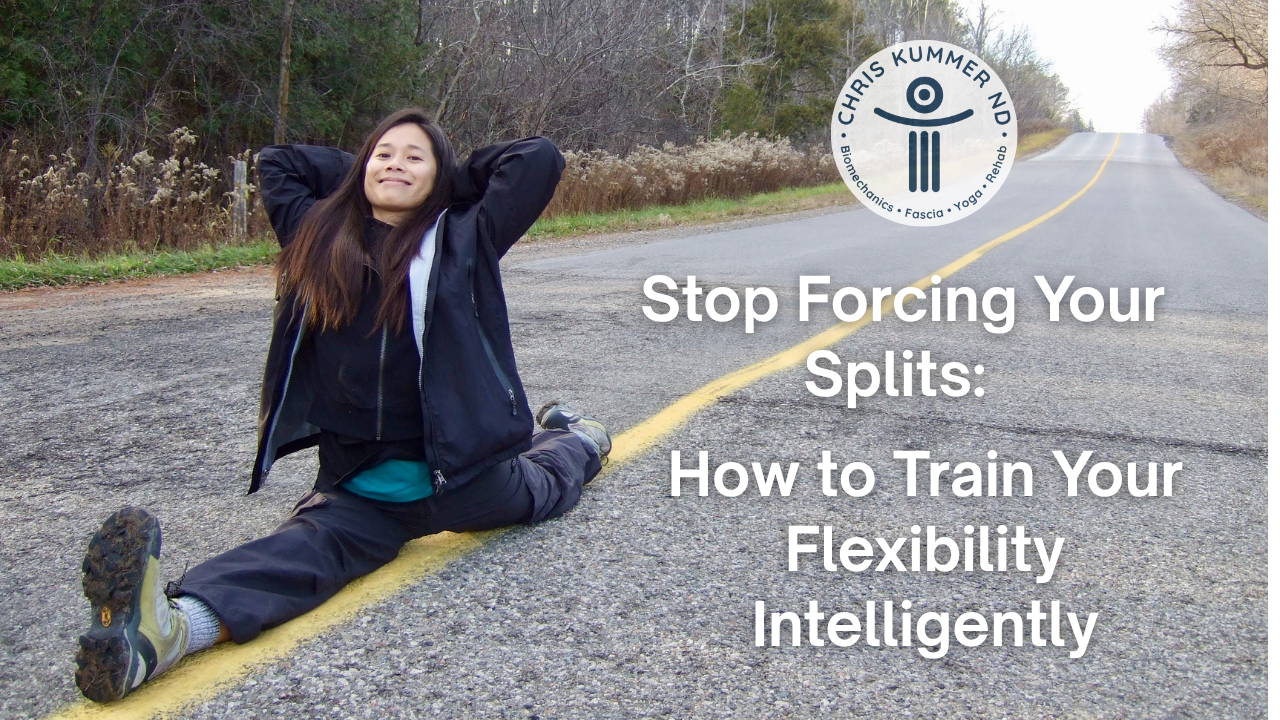
Stop Forcing Your Splits: How to Train Your Flexibility Intelligently
Aug 21, 2026There is a moment in almost every flexibility practice when you reach the edge.
The muscles begin to shake.
The stretch becomes intense.
You can see the floor getting closer.
And then comes the familiar decision:
Do I stay here—or push a little further?
If your goal is to achieve the splits, the temptation is obvious.
Go deeper.
Hold longer.
Push harder.
But developing useful mobility isn't simply about moving further into a position.
It is about developing the capacity to control, tolerate and use movement.
This is where active stretching becomes particularly interesting.
Rather than treating the body as something that needs to be pulled into flexibility, active stretching asks you to participate in the movement.
You don't just approach your barrier.
You engage with it.
What is the flexibility barrier?
Let's start with the simplest definition.
Your flexibility barrier is the point at which you currently encounter resistance to further movement.
But that resistance isn't necessarily one thing.
It may involve muscular tension, connective-tissue loading, joint structure, nerve tissue sensitivity, protective muscular activity, or a combination of several factors.
And your barrier isn't fixed.
It can change depending on your warm-up, fatigue, previous activity, emotional state, familiarity with the movement and the way you approach the position.
That doesn't mean every barrier should be pushed through.
Some barriers represent a useful limit.
Others can gradually change with appropriate training.
The skill is learning to tell the difference.
Stretching is not a battle
A common model of flexibility training is essentially a battle between you and your tissues.
You want more range.
Your body says no.
You apply more force.
Eventually, your body gives in.
That model creates a problematic relationship with movement.
If the only measure of success is getting deeper, then stronger sensation becomes evidence of progress.
But sensation and progress are not the same thing.
A more useful model is:
Explore the edge → create muscular control → load the range → recover → repeat.
Over time, the body gets more opportunities to adapt to the movement.
The aim isn't to defeat the barrier.
It is to gradually make the available movement more useful.
Why active stretching?
Active stretching combines movement into a range with muscular activity that helps create or control that range.
Instead of simply pulling the leg higher, for example, you may actively use the muscles around the hip to lift and control the leg.
Instead of sinking passively into a split, you may engage the legs and pelvis while maintaining the position.
This changes the training stimulus.
You're no longer asking only:
“How much range can I tolerate?”
You're also asking:
“How much of this range can I control?”
That is a much more functional question.
The difference between flexibility and usable mobility
Imagine two people who can both reach the floor in a split.
Person A can only get there by sliding into position with gravity and then needs to push against the floor to get back out.
Person B can lower into the position under control, maintain the organization of the legs and pelvis, and actively begin the movement out.
Visually, they may have the same flexibility.
Functionally, they don't have the same mobility.
The second person has developed strength and coordination within the range.
That distinction is important because movement doesn't happen at the end position.
It happens through the range.
Active stretching at the barrier
One of the most useful ways to practise is to approach your current barrier and then create an active effort there.
For example, in a front split preparation, you might move towards the deepest comfortable position you can control.
Rather than immediately trying to go deeper, gently engage the muscles of the legs.
You might imagine pulling the legs towards one another without actually moving them.
You might engage the front leg as though you were trying to draw it backwards.
You might engage the back leg as though you were trying to draw it forwards.
The exact cue is less important than the principle:
Create muscular activity while remaining within a controlled range.
This gives you a very different experience from simply dropping deeper.
The barrier becomes a place to work
This is where the concept of the “barrier” becomes useful.
Instead of treating your flexibility limit as a wall that must be broken through, think of it as a training boundary.
You can work near it.
You can breathe there.
You can create muscular effort there.
You can move slightly away from it and return.
You can explore different positions.
You can gradually build strength around it.
Over time, the boundary may change.
And if it doesn't change as much as you hoped?
That may be useful information too.
Your structural anatomy may simply place a different ceiling on the shape you are pursuing.
Remember Part 1:
Not every body is built to produce the same shape.
Training intelligently means respecting that reality.
Don't confuse intensity with adaptation
There is a persistent idea in flexibility training that the more intense the stretch, the greater the adaptation.
But tissue adaptation isn't simply proportional to how uncomfortable an exercise feels.
More force isn't automatically better.
In fact, excessive force can make it more difficult to distinguish productive loading from an unnecessarily aggressive stimulus.
A good training session doesn't need to leave you feeling like you've been pulled apart.
The goal is to expose the body to an appropriate stimulus that it can recover from and adapt to.
That principle applies to strength training.
It applies to endurance training.
And it applies to mobility training.
Fascia and the adaptation story
This is where our fascia thread returns.
Fascia is living connective tissue. It responds to mechanical loading and participates in the body's adaptation to movement.
But adaptation is not a simple process of “stretching the fascia longer.”
Connective tissues remodel over time. Muscles adapt. The nervous system learns. Coordination changes. Strength develops. Your perception of a movement changes.
All of these processes can contribute to changes in movement capacity.
This is why it is more useful to think about training the movement system than trying to manipulate one particular tissue.
Fascia is part of the system.
It isn't the solution to the system.
Why strength at the edge matters
When you actively engage muscles near the end of your range, you're asking them to produce force in a mechanically challenging position.
That has value beyond flexibility.
It helps you develop capacity where you actually want to move.
If your goal is to use a large range of hip movement, having strength near that range is useful.
The body doesn't only need to tolerate the position.
It needs to organize itself there.
This is particularly important for protecting joints and other vulnerable structures.
When muscles contribute appropriately, they can help manage forces and control movement rather than leaving passive tissues to absorb everything.
Again, the goal isn't to tense everything as hard as possible.
It is appropriate engagement.
Too little muscular control and you may collapse into the range.
Too much unnecessary bracing and you may make movement less efficient.
The skill lies somewhere between the two.
Active range can gradually catch up with passive range
One practical goal of flexibility training is to reduce the gap between the range you can access passively and the range you can control actively.
Suppose you can passively move your leg into a very high position, but you can only actively lift it halfway there.
Rather than spending all your time trying to increase the passive range even further, it may be more productive to develop strength and control in the range you already have.
Over time, that active capacity may increase.
And when active range improves, the body has more reason to regard that range as something it can actually use.
This is one of the reasons mobility training should include movement and strength, not just static stretching.
Variation is your friend
Another important part of intelligent flexibility practice is variation.
If you always practise the exact same split, from the exact same position, with the exact same intensity, you repeatedly expose your body to a very narrow movement experience.
Instead, explore different preparations.
Change the position of the pelvis.
Move in and out of the range.
Use different loading strategies.
Work at different intensities.
Explore active and passive components.
Train strength around the range.
And sometimes simply move.
The body benefits from having options.
A useful principle for movement education is:
The body adapts intelligently to what you repeatedly do, and it can also adapt in ways that reduce available options if variation is lacking.
Mobility isn't just about gaining centimetres.
It is about maintaining and expanding your movement options.
What should you actually feel?
This is perhaps more important than any particular exercise.
During a productive flexibility practice, you may feel tension, effort, stretching and muscular work.
Those sensations aren't automatically good or bad.
What matters is their quality and your ability to respond to them.
A diffuse stretching sensation in the muscles may be appropriate.
A strong but controllable muscular effort may be appropriate.
A sharp, pinching, catching or unstable sensation around a joint deserves more caution.
The answer isn't always to diagnose the sensation.
As movement practitioners, we can instead use it as information:
Can I change the position?
Can I reduce the intensity?
Can I create more muscular support?
Can I breathe normally?
Does the sensation change when I move rather than hold?
This keeps the practice exploratory rather than diagnostic.
A different way to practise the splits
If your goal is to develop your splits, consider making the process less about “getting down” and more about developing the components of the movement.
Start with an appropriate warm-up.
Explore the relevant joints through comfortable movement.
Approach the split gradually.
Find your current controlled edge.
Engage the muscles of the legs.
Spend time working around the edge rather than forcing beyond it.
Move in and out of the range.
Use active strength exercises that develop control near the positions you want.
Then allow recovery.
You don't need to make every session maximal.
In fact, repeatedly approaching your absolute limit may not be the most productive way to train.
Consistency usually beats drama.
And what if you never reach the floor?
This is worth saying explicitly.
You may practise intelligently, consistently and patiently and still never achieve a textbook split.
That doesn't mean your practice failed.
Your individual skeletal structure may influence the range available to you.
Your proportions may affect the shape.
Your joints may have different movement characteristics.
Your connective tissues may adapt differently from someone else's.
The goal of movement education is not to make every body conform to one ideal photograph.
It is to help people understand their own bodies well enough to make better movement choices.
The floor is not the teacher.
Your movement is the teacher.
Fascia is the thread, not the destination
We began this series by asking why the splits are more complicated than simply having “tight muscles.”
We then looked at the way the whole body participates in the movement and how fascia helps us understand continuity between regions.
Finally, we arrive at practice.
The practical lesson isn't that fascia needs to be released.
It isn't that fascia needs to be stretched.
And it certainly isn't that every flexibility limitation can be explained through fascia.
Instead, fascia gives us one useful perspective within a much larger picture.
Your movement emerges from the interaction of structure, joints, muscles, connective tissues, nervous-system regulation, breathing, coordination and training history.
Active stretching gives you a way to work with that system rather than simply fighting against it.
Approach your barrier.
Listen to it.
Engage.
Move.
Load.
Recover.
Repeat.
And allow the body to adapt over time.
The best flexibility practice isn't necessarily the one that gets you furthest into the pose today.
It may be the one that gives your body more options tomorrow.
Don't miss what's happening!
New posts, education, and movement ideas delivered to your inbox.
We hate SPAM. We will never sell your information, for any reason.
Blog post by:
