
It's Bigger Than the Body - Expanding the Practice
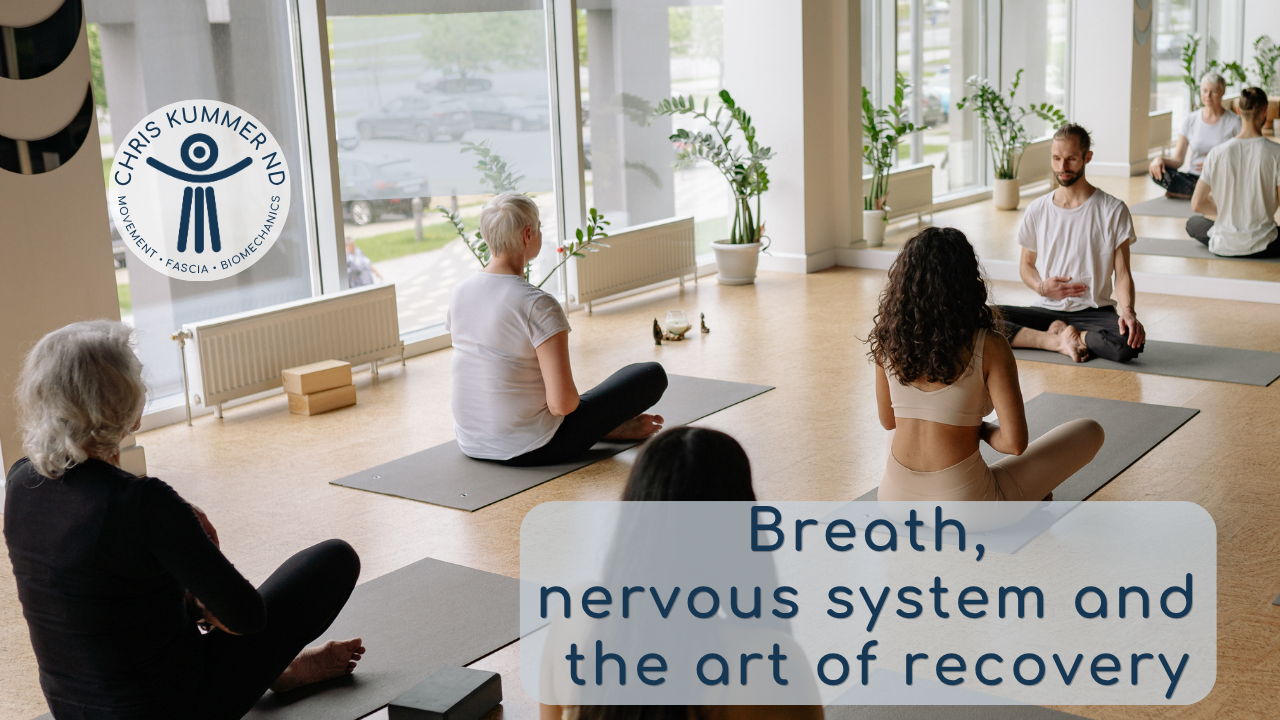
Oct 20, 2026Breath, nervous system and the art of recovery
In the first and the second article in this series, we explored why movement matters for longevity and how we can maintain our physical options as the body changes. Strength, mobility, balance and adaptability all contribute to our ability to keep participating in life.
But there is another side to a sustainable practice.
How well can we recover from effort? Can we recognise when we are pushing too hard, holding tension or rushing through a movement? Can we settle our attention when there is nothing left to achieve?
Breathing and stillness offer a way to explore these questions. They bring our attention beyond the shapes we make and the physical capacities we develop, towards how we experience movement and respond to what is happening within us.
A long life asks us not only to move well, but also to recover, regulate, pay attention and tolerate stillness.
Breathing is more than taking in air
Breathing is remarkable partly because it happens without requiring our conscious attention. The nervous system adjusts our breathing to meet changing demands, whether we are sleeping, walking, speaking or exercising.
At the same time, breathing is unusual because we can influence it voluntarily. We can take a deeper breath, change its pace, pause briefly or direct our attention towards the movement of the rib cage and abdomen.
This gives us an opportunity to explore the relationship between automatic processes and conscious participation.
The respiratory system does not operate in isolation. Breathing involves the diaphragm, intercostal muscles, rib cage, lungs and associated connective tissues. It also interacts with the pressure relationships within the thorax and abdomen, while the nervous system adjusts breathing in response to our activity and internal needs.
When we move, breathing helps meet the changing demands of the body. When we pay attention to breathing, we can also learn something about the way we organise movement.
Do you hold your breath when a pose becomes challenging? Does your breathing become restricted when you concentrate? Do you force yourself to breathe in a particular way, even when the movement would feel easier if you allowed your breathing to change?
These are useful questions because they shift the focus from achieving a prescribed breathing pattern towards understanding your own responses.
The relationship between breath and movement
Breathing is not simply something we add to movement. It is already part of how we move.
The diaphragm changes shape as it contracts and relaxes. The rib cage moves, abdominal pressure changes, and the trunk continually adjusts to the demands of breathing and posture. At the same time, movement influences breathing through changes in muscular activity, body position, effort and the space available for respiratory motion.
Try noticing this in a familiar movement.
As you raise your arms overhead, what happens to your rib cage? Can you sense movement through the sides and back of the ribs, or does most of the movement seem to occur at the front? Does your breathing change when you extend your spine, bend forwards or rotate?
There is no single breathing pattern that must accompany every movement. Coordinating breath with movement can be useful, and particular patterns may support the rhythm of a practice. But breathing should not become another instruction to obey at the expense of sensing what is happening.
If you are concentrating so hard on synchronising every movement with an inhale or exhale that you lose awareness of your body, it may be worth simplifying the task.
Allow the movement to develop first. Then notice how breathing responds. From there, you can explore whether a deliberate breathing pattern makes the movement feel more coordinated, comfortable or controlled.
The aim is not perfect synchronisation. It is greater awareness of the relationship between breathing and movement.
Recovery is a capacity, too
We often think of physical capacity in terms of strength, mobility or endurance. Yet the ability to recover is also important.
After effort, the body needs time to adjust. Heart rate and breathing gradually change, energy stores are replenished, and tissues undergo the processes associated with recovery and adaptation. The quality of this recovery depends on many factors, including the intensity of activity, sleep, nutrition, health and the demands of everyday life.
A yoga practice can provide opportunities to explore how we respond to effort and how we transition from activity to rest. Active sequences challenge our physical capacities; breathing practices and periods of stillness give us opportunities to practise responding differently to demand.
But recognising a response is only the beginning.
We can notice that we hold our breath under pressure, for example, without yet knowing how to change that habit. We can recognise that we struggle to settle after effort without having developed the ability to do so. Awareness gives us a starting point; practice allows us to experiment with alternatives, discover what helps and gradually develop new capacities.
This is where the idea of resilience becomes relevant.
Resilience is not about remaining calm regardless of circumstances, nor is it about being able to tolerate ever-increasing demands. It is about developing the capacity to respond to challenges, adjust when circumstances change and recover when the demand has passed.
Breathing offers one way to explore this process. We can practise maintaining a comfortable breath during manageable physical effort, noticing when we begin to strain, and finding ways to reduce unnecessary tension without abandoning the task. We can experiment with slowing the breath after activity and observe whether this helps us settle. Over time, we may become better able to recognise our responses and work with them rather than being carried along by familiar habits.
These capacities develop through repeated experience, not through understanding alone. They also extend beyond breathing: the same principle applies when we explore strength, balance, coordination and movement under changing conditions. We challenge ourselves within a manageable range, observe the response, adjust and try again.
The aim is not to eliminate stress or avoid discomfort. Some challenges are necessary for growth, and not every situation can be controlled through breathing or movement. Rather, we practise developing a broader range of responses, so that we have more options available when demands arise.
That is another way of making the practice bigger than the body. We are not only exploring what our bodies can do, but also developing our capacity to meet challenges, adapt and recover — skills that can serve us well both on and off the mat.
When breathing becomes a practice in its own right
We can also give breathing our deliberate attention without combining it with a complex movement.
Simply noticing the breath can reveal habits that usually pass unnoticed. Perhaps you breathe predominantly through the upper chest. Perhaps the abdominal wall remains tense, or the breath becomes shallow whenever you concentrate. You might discover that you regularly interrupt your breathing during effort.
These observations are not diagnoses, nor do they necessarily indicate a problem. They are starting points for exploration.
Begin in a comfortable position and allow your breathing to continue naturally. Notice the movement of the rib cage, the abdomen and, if you can sense it, the back of the trunk. Observe the length and ease of each breath without immediately trying to change it.
Then, if it feels comfortable, experiment with a slightly slower, quieter breathing rhythm. Avoid taking exaggeratedly deep breaths or forcing the exhalation to last longer than it comfortably can.
Notice what changes.
Does your breathing feel easier or more effortful? Does your attention settle, or do you become preoccupied with controlling the breath? Is there a difference between allowing a breath to develop and deliberately making it happen?
This distinction matters. More conscious effort does not always produce a better result. Sometimes, the most useful practice is learning when to intervene and when to allow an automatic process to continue.
Slow, comfortable breathing can influence aspects of autonomic regulation, including heart-rate patterns. For some people, it may also help reduce feelings of stress or arousal. However, responses vary, and no particular breathing method works in the same way for everyone.
Breathing practices are not competitions in breath depth, duration or control. If you feel dizzy, uncomfortable, anxious or short of breath, return to normal breathing and stop the exercise.
The value lies in developing a more attentive relationship with breathing, not in achieving an impressive technique.
Effort and recovery belong together
In a movement practice, we often focus on what we are doing: the pose, the muscular engagement, the range of motion or the effort required to maintain a position.
Yet our ability to respond to effort is just as relevant.
During physical activity, breathing adjusts to help meet the body's changing demands. After activity, the body gradually returns towards its previous state. Heart rate and breathing change, and the systems involved in supplying and using energy continue their work.
Recovery is not a switch we simply turn on. It is a collection of processes that unfold over time.
Our experience of recovery also depends on context. A demanding physical practice, a stressful day, insufficient sleep and the pressure of trying to achieve something can all affect how we feel when we finally stop moving.
This is where the quieter elements of yoga can become valuable.
After a sequence that requires strength, coordination or sustained effort, take a few moments to observe what happens when the effort ends. Notice your breathing without immediately trying to slow it. Feel the contact between your body and the floor. Allow your attention to register the transition from activity to relative rest.
Can you recognise that transition without rushing into the next task?
The point is not to make every practice calming. Nor should a quiet practice be considered inherently superior to a physically demanding one. We need opportunities to challenge our capacities, and we need opportunities to recover from those challenges.
A sustainable practice makes room for both.
Stillness is not the absence of practice
For many people, stillness sounds straightforward: stop moving, close your eyes and relax.
In reality, remaining still can be surprisingly demanding.
The body continues to breathe and make small adjustments. Sensations become more noticeable. Thoughts appear, attention wanders, and we may become impatient with the apparent lack of progress.
When movement stops, we lose some of the external tasks that normally organise our attention. There is no pose to refine, no transition to coordinate and no obvious physical goal to pursue.
This can make stillness a different kind of exploration.
Rather than trying to eliminate thoughts or achieve a particular state, we can practise noticing what is present. We might feel the breath, hear sounds around us or recognise tension in the jaw and shoulders. When attention wanders, we can notice that too and gently return to the experience of the moment.
There is no need to make the experience special.
Meditation is often described as a way to quiet the mind, but trying to force the mind into silence can become another demanding task. A more accessible starting point is simply to observe, without requiring every thought or sensation to disappear.
Over time, this kind of practice may help us recognise our habits of attention and our responses to discomfort, uncertainty or inactivity. It does not guarantee that we will always feel calm, but it can offer opportunities to become more familiar with our own responses.
Stillness, in this sense, is not an escape from life. It is a way of practising how we meet it.
Fascia, breathing and the whole-body perspective
Breathing also offers a useful reminder of how interconnected the body is.
The respiratory diaphragm is both a respiratory muscle and part of the system involved in managing pressure within the trunk. Its movement relates to the rib cage, abdominal contents, pelvic floor and the muscular and connective tissues surrounding these structures.
The lungs and their surrounding pleural membranes move in relation to the chest wall. Connective tissues help organise and connect the structures involved, while the movements of the ribs, spine and trunk influence the space and mechanics available for breathing.
This is one reason a fascia-informed perspective can enrich our understanding of the respiratory system. It encourages us to consider relationships between structures rather than treating each part as an isolated mechanism.
However, it is important not to make fascia responsible for everything we experience during breathing. Respiratory movement depends on the coordinated action of muscles, joints, connective tissues, the lungs and nervous-system control, among other factors.
If breathing feels restricted in a particular position, the answer is not automatically to stretch or release fascia. Position, muscular activity, respiratory demands, comfort and many other factors may be relevant.
Instead, we can explore how changing our position, moving the rib cage, reducing unnecessary effort or allowing more time for a breath influences our experience.
Again, the emphasis is on observation and understanding rather than assuming that one technique will solve every problem.
Making space for the long game
A sustainable yoga practice does not have to look the same every day.
Some days, we may benefit from challenging our strength, balance or coordination. On others, a gentler practice, attentive breathing or a few minutes of stillness may be more appropriate. The choice depends on our needs, capacities and circumstances.
This flexibility is not a failure to practise properly. It is part of learning how to practise over a lifetime.
The ability to adapt a practice matters because the body and our circumstances change. Energy, sleep, responsibilities, physical capacity and personal priorities are not fixed. A practice that serves us well for years must leave room for those changes.
Breathing and stillness can help us pay attention to the conditions we bring to practice. They invite us to notice when effort is useful, when we are adding unnecessary tension and when it may be time to pause.
They also remind us that not every valuable outcome is measured by how far we stretch, how long we hold a pose or how much effort we expend.
Sometimes, progress means moving with greater ease. Sometimes, it means recognising a habit we had never noticed before. And sometimes, it means being able to stop doing and simply pay attention.
A practice that supports a life
Longevity is not just about preserving physical abilities. It is also about remaining responsive to the changing demands of life.
Movement helps us build and maintain physical capacity. Varied practice gives us opportunities to explore different ways of moving. Breath and stillness offer another dimension: learning to notice, respond and recover rather than remaining caught in a constant cycle of effort.
None of these elements guarantees a particular outcome. But together, they can help us develop a more considered relationship with our bodies and our practice.
The long game is not about doing more forever. It is about understanding what we need, recognising what is changing and continuing to find ways to participate.
Movement builds capacity. Breath connects us to the process. Stillness gives us space to notice.
In the final article of this series, we will bring these ideas together and explore how to build a yoga practice that can evolve with us — one that supports not just a session on the mat, but the life we want to keep living beyond it.
Don't miss what's happening!
New posts, education, and movement ideas delivered to your inbox.
We hate SPAM. We will never sell your information, for any reason.
Blog post by:
